

In today’s digital economy, perception is currency.
You can have the best product, a strong team, and consistent revenue – but if your online perception is unstable, your growth will always feel fragile.
That’s why Social Media Reputation Management is no longer a PR afterthought. It’s a core growth strategy for founders, CEOs, and personal brands who want long-term authority.
At The Crown Media, we believe reputation isn’t repaired during crises – it’s engineered before them.
This in-depth guide will help you understand how to proactively manage, protect, and scale your brand reputation across social platforms in 2026 and beyond.
Table of Contents
What Is Social Media Reputation Management?

Social Media Reputation Management is the strategic process of monitoring, influencing, and strengthening how your brand is perceived across platforms like Instagram, LinkedIn, X, YouTube, and emerging digital channels.
It includes:
- Monitoring brand mentions and conversations
- Managing online reviews and public feedback
- Responding strategically to criticism
- Maintaining consistent brand messaging
- Creating authority-driven content
- Preventing and handling social media crises
In simple terms, it’s about controlling the narrative instead of reacting to it.
Why Social Media Reputation Management Is Critical for Founders
Today’s consumers don’t just buy products – they buy people, values, and transparency.
Before making decisions, they:
- Check your Instagram presence
- Read your comments
- Look at tagged posts
- Scan Google reviews
- Evaluate how you respond to criticism
Your response behavior influences purchasing decisions more than your ads.
Strong online reputation management ensures that your public perception reflects your expertise, professionalism, and credibility.
The Core Pillars of Social Media Reputation Management
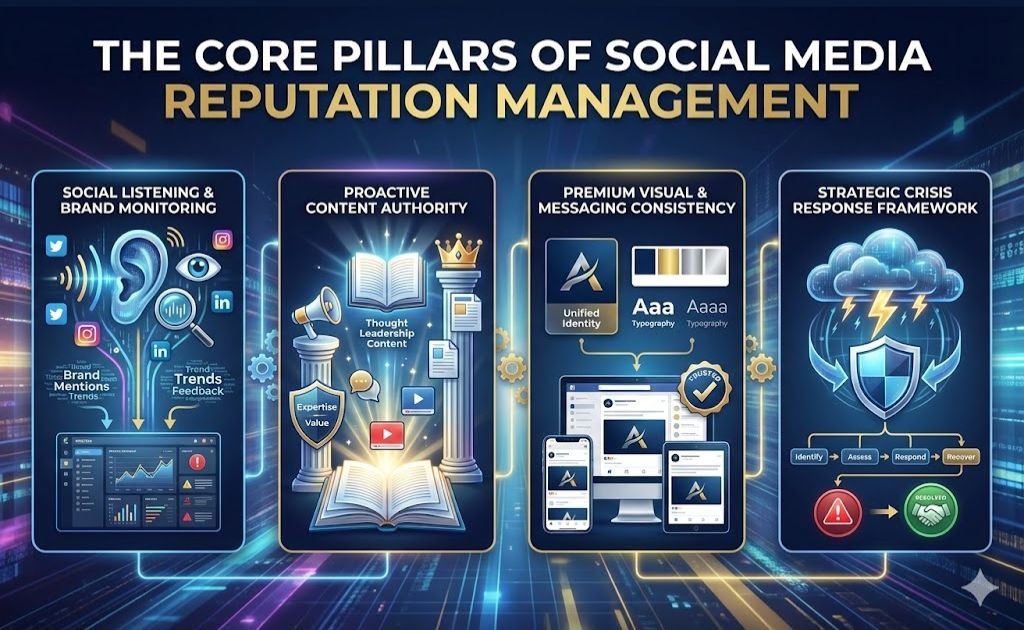
To dominate your niche sustainably, you need a structured ecosystem.
Here are the four foundational pillars.
1. Social Listening & Brand Monitoring
You cannot manage what you don’t measure.
Effective social media reputation management starts with tracking:
- Brand name mentions
- Founder name mentions
- Industry keywords
- Customer feedback
- Competitor conversations
- Sentiment patterns
Early detection allows brands to address issues before they escalate into public crises.
This is where professional systems matter – automated monitoring combined with strategic interpretation.
2. Proactive Content Authority
The best crisis prevention strategy is authority building.
When you consistently publish:
- Educational content
- Industry insights
- Founder stories
- Case studies
- Transparent updates
…you build credibility equity.
This equity becomes your shield.
Brands that invest in proactive brand reputation management on social media rarely suffer long-term damage from isolated criticism.
3. Premium Visual & Messaging Consistency
Reputation is shaped visually before it is understood logically.
Every pixel communicates something about your brand:
- Design quality
- Typography
- Image clarity
- Video editing
- Color psychology
- Tone of captions
Inconsistent visuals create subconscious distrust.
Professional founders treat content production like a structured studio process – not random posting.
At The Crown Media, we’ve seen firsthand how upgrading visual standards alone can elevate perceived authority dramatically.
4. Strategic Crisis Response Framework
Even the strongest brands receive criticism.
What matters is the response structure.
The 4-Step Social Media Crisis Management Model
Acknowledge Promptly
Silence increases suspicion.
Respond Calmly & Professionally
Never argue emotionally.
Take It Offline
Invite private resolution through DMs or email.
Close the Loop Publicly
Confirm resolution once handled.
Handled properly, negative comments can increase trust rather than damage it.
Transparency builds credibility.
Social Media Reputation Management vs. Online Reputation Management
While often used interchangeably, there’s a difference.
Online Reputation Management (ORM) covers:
- Google search results
- Review platforms
- Blogs
- Forums
- News mentions
Social Media Reputation Management focuses specifically on:
- Social platform perception
- Comment sections
- Direct engagement
- Influencer interactions
- Viral content risks
For founder-led brands, social media reputation is often the most volatile – and therefore the most critical.
Common Social Media Reputation Mistakes Founders Make
Avoid these high-risk behaviors:
- Deleting legitimate negative comments
- Responding emotionally
- Ignoring customer feedback
- Inconsistent branding
- Over-promoting without value
- Trend-chasing without alignment
- Posting without strategic oversight
Reputation damage usually isn’t caused by a single event – it’s caused by repeated inconsistency.
The ROI of Strong Social Media Reputation Management
When managed strategically, reputation delivers measurable results:
✔ Higher customer trust
✔ Increased conversion rates
✔ Stronger referral networks
✔ Premium pricing authority
✔ Investor confidence
✔ Crisis resilience
✔ Long-term brand equity
Trust compounds.
And compounded trust becomes competitive advantage.
When Should You Hire a Social Media Reputation Management Agency?
As your brand grows, managing perception becomes more complex.
If you are:
- Scaling rapidly
- Receiving high engagement
- Attracting media attention
- Managing public-facing leadership
- Launching new ventures
…you need structured oversight.
Professional agencies bring:
- Monitoring systems
- Crisis playbooks
- Messaging alignment
- Content authority frameworks
- Visual brand consistency
- Strategic positioning
At The Crown Media, our approach to Social Media Reputation Management focuses on building long-term digital equity – not temporary visibility spikes.
We don’t just manage comments.
We architect perception.
The Crown Media Approach to Social Media Reputation Management
Our philosophy is simple:
Reputation is not damage control. It is digital legacy management.
We combine:
- Personal branding strategy
- Studio-level content production
- Authority positioning
- Narrative alignment
- Crisis preparedness systems
For founders who want stability, influence, and long-term authority – not short-term virality.
Because in 2026, the brands that win are not the loudest.
They are the most trusted.
Final Thoughts: Your Reputation Is Your Leverage
In today’s digital-first world:
- Your comment section is your public courtroom.
- Your visuals are your credibility markers.
- Your responses are your character references.
Social Media Reputation Management is no longer optional for serious founders.
It is protection.
It is positioning.
It is power.
If you want to build a brand that survives scrutiny and scales with authority, your reputation strategy must be intentional – not accidental.
And the time to build it is before you need it.