

Why This Guide Matters in 2026
The coaching industry is booming – but in 2026, being a great coach alone is not enough. The real difference between coaches who struggle and coaches who thrive is not talent. It’s visibility, trust, and positioning.
Clients today choose the coach who feels like the most credible and relevant expert before they ever book a call. That decision is influenced by what they see online: your messaging, your clarity, your proof, and your consistency. That’s why personal branding is now the foundation of a premium coaching business.
This blog is your complete blueprint to build a strong personal brand in 2026 – so you can stand out in a crowded market, attract high-quality clients, and charge premium rates confidently.
Table of Contents
1. Why Personal Branding for Coaches is Non-Negotiable in 2026
The coaching market has grown massively over the last few years, creating both opportunity and competition. With more coaches entering the space every year, clients have endless options—and attention spans are shorter than ever.
Here’s what makes personal branding non-negotiable:
- More competition means being skilled is not enough
- Clients make decisions based on trust signals
- People pay premium prices only when they see authority + proof + clarity
- A strong brand reduces client hesitation and increases conversions
What happens when you don’t build a personal brand?
Without strong branding, you become easier to ignore and easier to compare. Clients start looking at you like a commodity and focus on price instead of value.
What happens when you do build one?
Personal branding makes you the obvious choice. It increases your inbound leads, improves conversion rate, and lets you charge premium pricing because clients feel confident you’re worth it.
2. The Personal Branding Crisis Most Coaches Face
Most coaches aren’t struggling because their coaching is weak. They struggle because they’re not visible enough—and their message isn’t clear enough for the market to understand.
During interviews with coaches across niches, the most common statement was:
“My clients get results, but I don’t get consistent leads.”
This happens because of three common traps.
Trap #1 — The Visibility Trap
Many coaches post inconsistently and rely heavily on referrals. In 2026, inconsistency kills trust. If your audience doesn’t see you regularly, they don’t remember you—and if they don’t remember you, they don’t choose you.
Trap #2 — The Commoditization Trap
When your messaging sounds like everyone else, clients assume you offer the same value as everyone else. That forces you into price comparisons and fee negotiations.
Trap #3 — The Credibility Trap
Credentials alone don’t build trust anymore. Clients need visible evidence that you can deliver results.
They look for:
- testimonials
- case studies
- clear frameworks
- consistent content
- transformation stories
3. The Crown Framework: 5 Pillars of Unstoppable Coach Branding
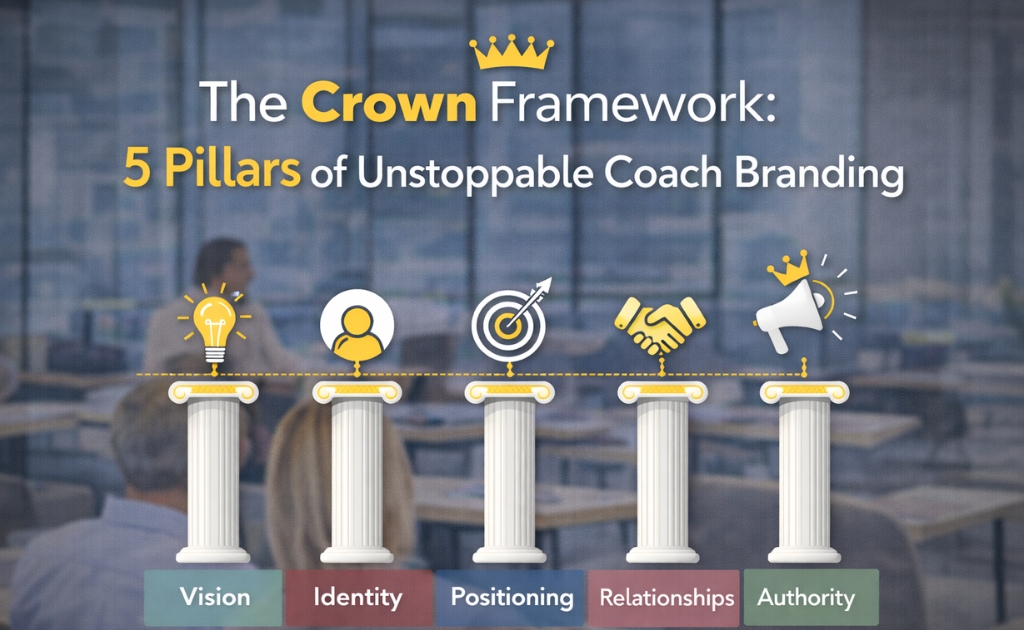
At The Crown Media, we build premium coaching brands using a simple structure called the Crown Framework. These five pillars are what make a coach brand feel premium, trustworthy, and powerful.
Pillar 1 — Crystal-Clear Positioning
Positioning is the foundation of your brand. It should clearly communicate:
- Who you help
- What transformation you deliver
- Why you are uniquely qualified
❌ “I’m a coach.”
✅ “I help burnt-out executives rebuild energy and confidence using neuroscience-backed coaching.”
Clarity makes you memorable. Vagueness makes you invisible.
Pillar 2 — Authentic Authority
Authority is not about followers. It’s about credibility and proof. The fastest way to build authority is to teach consistently and show results publicly.
Strong authority signals include:
- client wins
- frameworks and methodologies
- insightful content
- podcast/speaking appearances
- collaborations with experts
Pillar 3 — Consistent Visibility
Visibility creates familiarity. Familiarity creates trust. Trust creates premium clients.
In simple terms:
show up consistently → become trusted → become chosen
This doesn’t mean posting daily. It means having a predictable rhythm.
Pillar 4 — Authentic Storytelling
Clients don’t connect with “perfect.” They connect with real.
A strong coach brand shares:
- your origin story
- what you believe about transformation
- lessons you’ve learned
- client transformation journeys
Story builds emotional trust faster than logic.
Pillar 5 — Strategic Differentiation
Premium brands are clear about boundaries. Differentiation is not trying to impress everyone. It’s confidently stating:
- who you are for
- who you are not for
- your method
- your results
- your coaching philosophy
This instantly attracts high-ticket clients who want certainty.
4. How to Brand Yourself as a Coach: The 7-Step System
Now let’s get into the real blueprint. This 7-step system helps you build a premium personal brand from the ground up.
Step 1 — Define Your Unique Value Proposition (UVP)
Your UVP is your brand in one sentence. It should be specific, outcome-driven, and niche-focused.
Use this formula:
I help [specific audience] go from [pain/problem] to [desired outcome] through [your method], so they [big benefit].
A powerful UVP should feel like:
✅ “This coach understands me.”
Step 2 — Craft Your Brand Story
Your story builds trust at scale. It should communicate:
- what made you become a coach
- the struggle or lesson that shaped you
- your philosophy on transformation
- proof through client results
People don’t buy coaching. They buy belief in you.
Step 3 — Build Your Credibility Stack
Premium clients don’t trust claims. They trust evidence. Build a credibility stack by collecting proof intentionally over time.
Examples of credibility assets:
- certifications and training
- years of experience
- testimonials and reviews
- 2–3 detailed case studies
- speaking engagements
- collaborations and guest features
- LinkedIn recommendations
Step 4 — Create Your Signature Methodology
A named system makes you memorable. It also positions you as a specialist instead of a generic coach.
Examples:
- “The Burnout Reset Blueprint”
- “The Confidence Rebuild Method”
- “The Executive Growth Framework”
Your signature methodology becomes your intellectual property.
Step 5 — Build a Premium Online Presence
Your website and LinkedIn should instantly reflect premium positioning.
Website should include:
- UVP on homepage
- story-based About page
- services page with clarity
- testimonials and results
- CTA (Book / Apply / Message)
LinkedIn should include:
- headline with UVP
- About section with story + positioning
- featured proof
- posting rhythm (2–3 per week)
- recommendations
Step 6 — Create Content That Builds Trust
The easiest way to build authority is content—when it’s structured and consistent.
Your content should include:
- Educational posts (solutions + insights)
- Transformation content (client wins, before/after)
- Personal content (your story, values, lessons)
- Authority content (frameworks, systems, unpopular truths)
Consistency beats intensity.
Step 7 — Amplify Your Brand
Even great content needs distribution. Amplification increases your reach without increasing your work.
Best amplification methods:
- collaborations and joint lives
- guest posting in niche blogs
- podcasts and interviews
- webinars and summits
- repurposing content across platforms
- community engagement
Create once. Distribute everywhere.
5.Building a UVP Clients Can’t Resist
Many coaches struggle because their UVP sounds generic. The more generic your message is, the more price-sensitive your leads become.
Weak UVPs sound like:
- “I help people grow.”
- “I help you achieve goals.”
- “I provide accountability.”
A premium UVP answers four questions:
- Who exactly do you help?
- What struggle do they face?
- What result do they want?
- What method makes you different?
Specificity attracts premium clients. Generality attracts bargain buyers.
6. The Authority Accelerator: 5 Critical Mistakes Coaches Must Avoid
Most branding failures come from these mistakes.
Mistake #1 — Being Too General
Fix: Pick a clear niche and speak directly to that audience.
Mistake #2 — No Visible Proof
Fix: Start collecting testimonials + case studies immediately.
Mistake #3 — Inconsistent Posting
Fix: Create a weekly posting rhythm and stick to it.
Mistake #4 — Hiding Personality
Fix: Share values, beliefs, and real opinions.
Mistake #5 — No Authority Strategy
Fix: Build credibility through speaking, publishing, and partnerships.
7. Personal Branding Across Platforms (2026 Multi-Channel Strategy)
You don’t need to be everywhere. You need to be consistent in the right places.
A powerful 2026 strategy looks like this:
- Website: credibility + conversions
- LinkedIn: authority + inbound leads
- Email: nurture + long-term sales
- Blog: SEO + evergreen traffic
- Video: faster trust building
Start with 1 main platform + 1 support platform, then expand.
8. Real Coaching Success Stories: Branding in Action
One executive coach clarified her positioning, started posting 3 times a week on LinkedIn, and published strong case studies. In six months, her pricing doubled and she built a waiting list.
Another coach narrowed down from “life coaching” to a specific audience and built content around that niche. Within eight months, referrals increased and income tripled because she became known as the go-to expert.
A leadership coach developed a signature framework and made it the center of his website, content, and speaking. Within 12 months, he received media invites and consulting opportunities because his method became recognizable.
This is what branding does—it turns coaching expertise into market authority.
9. Coach Branding Strategy for Different Niches
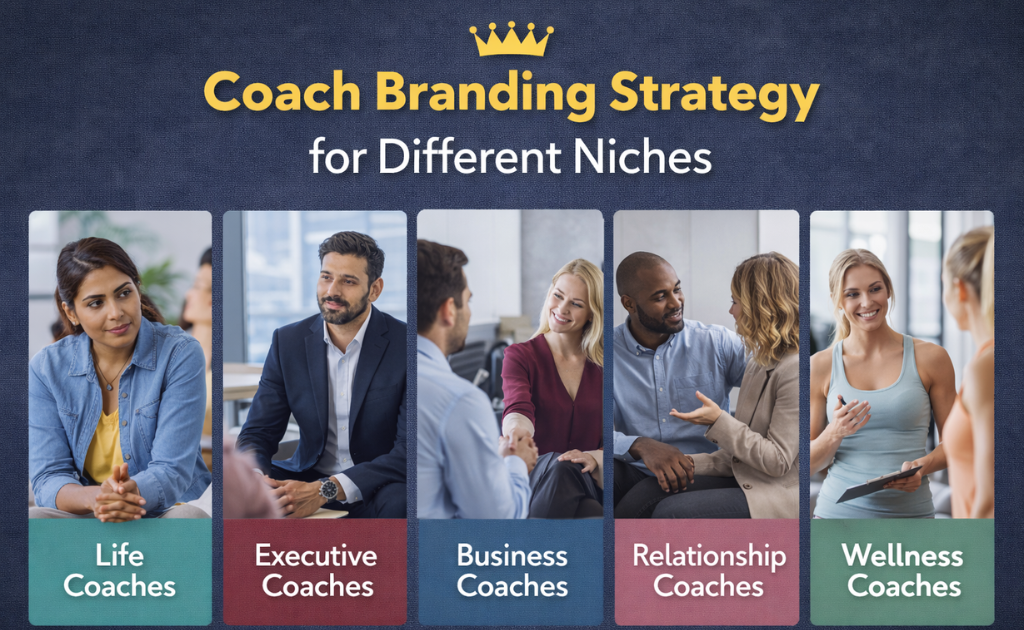
- Life Coaches: transformation stories + emotional connection
- Executive Coaches: frameworks + performance metrics
- Business Coaches: revenue results + scaling systems
- Relationship Coaches: communication insights + relatable storytelling
- Wellness Coaches: education + proof + lifestyle systems
Your strategy should match where your clients build trust.
10. Your Personal Branding Checklist (2026 Action Blueprint)
Week 1–2
Clarify your UVP, niche, story, and signature method.
Week 3–4
Optimize your website and LinkedIn. Add proof and CTAs.
Month 2–3
Build a 30-day content calendar. Publish consistently.
Month 3–6
Begin authority building: partnerships, speaking, podcasts, guest posts.
Final Word: Your Personal Brand is Your Coaching Future
In 2026, personal branding for coaches is not a luxury. It is the foundation of premium coaching success. The coaches who thrive aren’t always the most talented—they are the most clear, visible, and trusted.
Start with one step this week. Define your UVP. Share proof. Post consistently. Build authority slowly and strategically. The compounding effect will change your business.
Your future clients are already searching for you.
Your personal brand is how they find you.
Ready to Build Your Unstoppable Coaching Brand?
Download the free Personal Branding for Coaches – Blueprint.
Or book a Personal Brand for Coaches Strategy Call with our team.
About Crown Media
Crown Media is built by real-time personal branding experts who understand the digital world deeply.
We help entrepreneurs and businesses shift from traditional marketing to powerful online communication—transforming offline credibility into a strong and trusted online presence.
Led by Nizamudeen and Meera Begum, we focus on building brands that go beyond followers—brands built on trust, clarity, and visibility.
Your story deserves to be seen. We help make it unforgettable.